
1. Application
This URUS Sanctions and Export Compliance Policy (this “Policy“) applies to URUS Group LP and its family of direct and indirect subsidiaries and aƯiliates (collectively and individually, “URUS” or collectively, the “URUS GROUP“) and to all URUS employees, oƯicers, and directors (collectively, without regard to actual employment status of directors, “Employees” and each, an “Employee“). Additionally, this Policy applies to: (1) representatives, agents, and contracted personnel of URUS, and to such other individuals, companies, and other legal persons as designated by URUS from time to time (collectively, “Representatives” and each, a “Representative“); and (2) all individuals, companies, and other legal persons (and their respective employees, oƯicers, and directors) that perform services for or on behalf of URUS, including supply chain business partners, suppliers, consultants, contractors, distributors, sales agents/representatives, and other agents (collectively, “Associated Persons” and each, an “Associated Person“).
URUS will provide training, as deemed appropriate, to Employees, Representatives, and Associated Persons on the requirements of this Policy as well as on applicable Trade Laws. This training may occur on a periodic basis, or as deemed appropriate or necessary by Finance or management. Employees, Representatives, and Associated Persons shall periodically, whenever requested by URUS (and, in the case of Representatives who have access to URUS systems and Employees, at a minimum once a year) individually confirm in writing to URUS that they have read this Policy and agree to comply with it. When appropriate, and as a condition of doing business with URUS, URUS may require Representatives and Associated Persons to confirm in a signed writing that they comply (and will continue to comply) with, and agree to the terms and conditions outlined in, this Policy.
This Policy governs URUS’ approach to Trade Laws (as defined in Section 2 below) and relates to the laws of all countries/jurisdictions in which URUS or a URUS distributor acts or operates (including where URUS is about to commence operations) or where URUS is registered or licensed (collectively, all such countries/jurisdictions are where URUS “Operates“).
All members of the URUS GROUP (including, without limitation, Alta Genetics USA, LLC, Alta Genetics, Inc., Genex Cooperative, Valley Agricultural Software Inc., and Trans Ova Genetics, L.C.) are required to comply with all applicable Trade Laws imposed and administered by the US Treasury Department OƯice of Foreign Assets Controls, the U S Department of Commerce, and other relevant US enforcement authorities, as well as the Trade Laws of all other countries/jurisdictions in which it Operates.
2. Purpose
The URUS GROUP is committed to following all applicable trade laws at all times, including laws, rules, regulations, and policies governing economic sanctions (“Economic Sanctions “) and governing export and technology transfer controls (“Export Controls“, and together with Economic Sanctions, collectively, “Trade Laws“). These Trade Laws include laws and regulations promulgated by the governments of the United States, the European Union, the United Kingdom, and Canada, and by all other governments in countries/ jurisdictions where URUS Operates.
While there are some similarities among Trade Laws of various countries/jurisdictions, each country/jurisdiction has diƯerent laws, rules, regulations, and policies that are administered by diƯerent governmental agencies. This Policy is intended to facilitate URUS’ compliance with all applicable Trade Laws and to reduce reputational, operational, and legal risks that could arise from the potential violation of Trade Laws. As appropriate, URUS consults with legal counsel who specializes in Trade Laws to address any compliance issues or concerns.
3. How to Comply with Trade Laws – Overview
To comply with Trade Laws (whether doing business across borders, with international parties, or otherwise):
- You must conduct due diligence so that you can confirm (pursuant to Section 6 below) that both of the following are true:
- Economic Sanctions – Sanctions Lists. The parties involved in each transaction, including their direct or indirect owners (over 50%), controlling parties, and any involved banks, do not appear on any relevant sanctions lists; and
- Export Controls – Prohibited/Restricted Items. Any good, service, technology, or other information that we wish to export (each, an “Item for Possible Export“) is not subject to licensing or restrictions (unless there is full compliance with any such licensing/restrictions) and is not prohibited.
- You must consider whether it is appropriate to have the relevant non-URUS parties execute/sign and deliver to URUS the attached URUS Sanctions and Export Compliance Certificate. For reasons that will be clearer below, it can be helpful for you to have nonURUS parties execute/sign and deliver such certificate, and the Legal Department recommends that you do so.
4. How to Comply with Trade Laws – Step 1: Guiding Principles
All requirements and considerations outlined within this Policy must be read and understood in the context of the following guiding principles:
- We do not, directly or indirectly, do any business with entities or individuals that are subject to economic sanctions. This prohibition applies not only to the physical transfer of goods, technology, and services but also applies to the sharing of information by email or phone.
- We do not, directly or indirectly, do any business with entities that are directly or indirectly owned or controlled by entities or individuals that are subject to economic sanctions. An entity is considered to be owned by a sanctioned party if one or more sanctioned parties hold 50% or more of the shares (or other equity interests) in that entity. An entity is considered to be controlled by another entity or individual if such entity/individual has controlling rights or can exercise a decisive influence. The determination of whether an entity is owned or controlled by a sanctioned party is assessed using a number of criteria but is ultimately decided by the relevant authority within a country/jurisdiction on a caseby-case basis.
- We do not, directly or indirectly, deliver any good, technology, service, or information that is subject to export controls (unless an appropriate license has been issued by the applicable governmental/ national authority).
This Policy governs URUS’ approach to Trade Laws.
- URUS maintains this Policy to meet obligations under the Trade Laws of the countries/jurisdictions in which it Operates.
- URUS complies with the requirements of the Trade Laws of the US, Canada, the UK, the EU, and other countries/jurisdictions (whenever these apply to URUS’ operations or wherever URUS Operates) and will not undertake any business that would breach these Trade Laws.
- URUS may decide not to provide products, technology, services, or information, even when it is permitted by law, especially when the circumstances present reputational risk.
- URUS will comply with the terms and conditions relating to Trade Laws that are contained in its written agreements with its banking and other financial services suppliers.
- URUS will not undertake any business that would violate any applicable Trade Laws.
5. How to Comply with Trade Laws – Step 2: Due Diligence
Learn the answers to the following questions (to be able to perform the screening described in Section 6 below):
Economic Sanctions – Sanctions Lists:
- Does the size of the transaction exceed the dollar threshold set forth in the URUS Sanctions Screening Instructions (attached)?
- Might any high-risk country/jurisdiction be involved and if so, what are the details?
- Who is the applicable URUS customer or provider and what countries/jurisdictions are associated with them?Who owns or controls that party (all the way up the chain) and what countries/jurisdictions are associated with them?Who acts on the behalf of that party (for example, agents or distributors) and what countries/jurisdictions are associated with them?If applicable, what banks are involved?In the case of a software-related Item for Possible Export, who is the end user and what countries/jurisdictions are associated with them?
- Learn the country of organization/nationality, legal name, and primary address of each non-URUS party involved in a transaction, as well as their more common name(s), and in which countries/jurisdictions they Operate.
- You may also need to do the following (after you’ve performed the primary screening required by Section 6 below):
- If the party being screened is an entity (instead of an individual, sole proprietor, or other non-legal entity), learn the country of organization/nationality, legal name, and primary address of each direct and indirect owner (over 50%) and controlling party (all the way up the chain). Learn the same for each end user (all the way down the chain, excepting only the names of the farmers/herdsmen with whom URUS doesn’t have a direct relationship) and learn the same for their respective direct and indirect owners (over 50%) and controlling parties (all the way up their chain).
- Learn the same for all banks involved.
- Perform any additional due diligence (like obtaining copies of passports, tax identification numbers, or similar information) as may be needed to properly perform all applicable steps of the screening described in Section 6
- Where would the Item for Possible Export be going (in other words, what is the end destination of the good, service, technology, or other information) and through what countries/jurisdictions would it travel?
- What is the Item for Possible Export and what countries/jurisdictions have been, or will be, involved?
- Learn what the Item for Possible Export is and learn all countries/jurisdictions that would be linked to the Item for Possible Export in any way, whether by brand, origin of the Item for Possible Export, origin of its components, place of shipment, place of reexport/transfer, and/or payment currency.
Export Controls – Prohibited/Restricted Items:
- Could the Item for Possible Export be used for military or strategic applications (even if its primary use is for civilian applications)?
- Might the Item for Possible Export be a restricted biological agent or any other restricted item?
- What is the use (and possible uses) of the Item for Possible Export?
- Learn what the Item for Possible Export is used for and what it could be used for. With that knowledge and with what you learned above about all countries/jurisdictions involved, proceed to Section 6 below.
6. How to Comply with Trade Laws – Step 3 – Screening
Economic Sanctions – Sanctions Lists. Once the information described in Section 5 is obtained, it must be used to screen the applicable non-URUS parties pursuant to the URUS Sanctions Screening Instructions (attached). Note that, as described in those Instructions, there are two steps to the screening:
- First, determine whether an in-depth search/screening of the parties involved is required (in other words, whether high-risk countries/jurisdictions are involved or whether the transaction value exceeds the dollar threshold set forth in the URUS Sanctions Screening Instructions (attached)), and
- Then, if one or both of those situations exist, perform an in-depth screening of the parties to make sure none are restricted. URUS must not conduct business with any individual/entity for which economic sanctions apply (as will be discovered through the in-depth screening steps described in those Instructions).
The first step can be performed by all Employees, Representatives, and Associated Persons, and the second step (the in-depth screening) can be performed by you (if you are a URUS Employee) or by your export specialist, the CFO of your URUS Opco, Procurement, or Finance. If your URUS Opco doesn’t have access to a screening tool that performs screening for economic sanctions, you may request access to the screening tool from the Legal Department.
Export Controls – Prohibited/Restricted Items (from or through the US). Before exporting any Item for Possible Export from or through the US, perform all of the foregoing steps and if (and only if) no party is restricted:
- First, determine whether any intermediary or the ultimate destination of the Item for Possible Export is in a High-Risk Region as defined in Section 3(C) of the URUS Sanctions Screening Instructions (attached).
- If it is not in a High-Risk Region, determine whether it fits into one of the following categories (which makes it “a low-risk EAR99 item” pursuant to the US government), in which case we are allowed to export it:
- Bulls;
- Cattle Embyros;
- Bull Semen;
- DairyComp and its accompanying apps and modules;
- Cryogenic freezer tanks specifically designed for requirements of artificial insemination operations; and
- Food for humans or animals.
- If it is in a High-Risk Region, one of three things will be true – see the Legal Department for written/electronic confirmation of which is applicable:
- the Item for Potential Export is banned and cannot be exported;
- a valid license is required and/or restrictions must be complied with to export the Item for Potential Export; or
- the Item for Potential Export is deemed to be a low-risk EAR99 item, in which case we may (or may not) be allowed export it as the Legal Department will help you ascertain.
Export Controls- Prohibited/Restricted Items (outside the US). Before exporting any Item for Possible Export from or through a country/jurisdiction outside the US, consult with outside legal counsel to determine which regulatory export controls may apply and be sure to comply with them. If you are unsure which outside legal counsel to contact, contact the Legal Department for guidance.
7. Obligations and Consequences of Non-Compliance
Employees, Representatives, and Associated Persons must read and comply with this Policy. Under no circumstances may any Employee, Representatives, or Associated Person act to avoid any obligations with respect to Trade Laws or to avoid detection of a relationship or transaction that would violate this Policy.
URUS, Employees, Representatives, and Associated Persons must not advise customers or others about how transactions may be structured or presented to evade applicable Trade Laws or this Policy. This prohibition includes, but is not limited to, advising customers or others to amend any information or documents to include false or misleading information, omitting accurate information, or changing, removing, or omitting information from a transaction or any business record that would otherwise lead to detection of an issues with any Trade Laws.
Failure to comply with applicable Trade Laws constitutes a breach of legal requirements and this Policy and can expose URUS to significant reputational damage, legal and regulatory actions, and financial loss. Such failure to comply can also expose individual Employees, Representatives, and Associated Persons to substantial fines and imprisonment.
URUS may terminate a business relationship with any Associated Person (including terminating all contracts and agreements in force between URUS and any such Associated Person) by means of written notice to the Associated Person, with immediate eƯect, without need of judicial recourse, and without liability for compensation or damages (whether direct and/or indirect) of any type or nature in favor of such Associated Person, if: (1) the Associated Person fails to comply with any provision of this Policy and fails to remedy (if such a failure is remediable) that failure within 10 days of the Associated Person being notified in writing or electronically of the failure; or (2) the Associated Person becomes a listed person under Trade Laws or becomes the subject or target of Trade Laws.
8. Revisions and Confirmation
URUS will unilaterally review this Policy on a regular basis in its exclusive discretion and will introduce additions, changes, and deletions when it deems it necessary or appropriate to do so.
| Document Control | |
| Version | 3.2 |
| Date released | 2026.05.01 |
| Author(s) | Member of Legal Department (Tina Wilcox) & General Counsel (Jen Wellnitz) |
| For Questions Contact | Member of Legal Department (Tina Wilcox) |
| Responsible | General Counsel (Jen Wellnitz) |
| Accountable | CEO URUS (Paul Hunt) |
| Consulted/Approved | CFO URUS (Ryan Gaines) |
| Informed | • Rabobank – Executive Director, Leveraged Lending, North America (Ellen Ruschhaupt with a cc to Alison Young and Drina Guneri) • Rabo Securities USA, Inc. – Managing Director, Corporate Client Coverage (Matthew Plominski) Functional Leaders: • People (Molly Sloan) – to cascade to all, especially via the URUS Policies and Procedures Manual (f.k.a. Corporate Policy Manual) • Global Supply Chain (Tyler Dash) • Communications – Manager Corporate Communications (Anne Baehnman) Finance (Corporate): • CFO URUS (Ryan Gaines) – to include in BOA • VP of FP&A (Jessica Matlock) • Tax Director (tbd) • Treasurer (Alex Alt) • HQ Controller (Bethany Kreiter) • Global Operations (Sander Flanderijn) • SVP Finance & Control (Hans Hannema) • VP of Commercial Finance (Ryan Kupres) • Noth America Controller (Greg Keibel) Alta Business Controller (Daman Gahunia) Region/Function Finance Leaders: • VAS (Kelsy Boyd) • TOG (Chad Feenstra) • N. America Commercial (Pat McAllister) • EMEA Commercial (Ineke Murra) • Latam Commercial (Thaina Generoso) • APAC Commercial (Jan Kvasnicka) • UEB (not listed elsewhere) • Paul Hunt • Kevin Muxlow • Petra Vijverberg • Ty Vaughn • Legal Department: • General Counsel (Jen Wellnitz) • Member of Legal Department (Tina Wilcox) • Member of Legal Department (Brian Scully) • Legal Assistant Contractor (Stef Lord) |
URUS Sanctions and Export Compliance Certificate
This certificate is provided by or on behalf of the following non-URUS party:
___________________________ (“Certifier“).
- Compliance with Laws. Certifier acknowledges and understands that it is the written and established policy of URUS Group LP and its family of direct and indirect subsidiaries and aƯiliates (collectively and individually, “URUS” or collectively, the “URUS GROUP“), including, without limitation, Alta Genetics Inc., Alta Genetics USA, LLC, and Genex Cooperative, to comply fully with all applicable laws, rules, and regulations of all countries and jurisdictions in which URUS does business. Certifier agrees that it will not take any action that would constitute a violation, or implicate URUS in a violation, of any law, rule, or regulation of any country or jurisdiction, including, without limitation, laws relating to export controls and economic sanctions.
- Export Control and Economic Sanctions Compliance. Certifier acknowledges and agrees that URUS and its agents and representatives are required to comply with Canadian, U.S., and European laws, rules, and regulations that impose restrictions on exports of or trade in controlled goods, services, technology, and information (“Export Controls“) and on direct or indirect business dealings and financial transactions with restricted persons, destinations, end users, or end uses (“Economic Sanctions“, and together with Export Controls, “Trade Laws”).
In furtherance of URUS’ Trade Laws compliance obligations and policies, and without limitation to the certifications and agreements above, Certifier represents, warrants, and agrees that:
- neither Certifier nor any of its oƯicers, owners, agents, or employees is currently listed on any applicable international economic sanctions lists;
- Certifier is not owned in the aggregate, directly or indirectly, 50 percent or more by one or more persons listed on any applicable international economic sanctions lists[1];
Applicable economic sanctions lists include, but may not be limited to: (1) the United Nations Security Council Consolidated Sanctions List – searchable at https://main.un.org/securitycouncil/en/content/un-sc-consolidated-list, and https://search.sanctions.un.org/; (2) the Consolidated Special Economic Measures Act Sanctions List maintained by Global Affairs Canada – searchable https://www.international.gc.ca/world-monde/international_relationsrelations_internationales/sanctions/consolidated-consolide.aspx?lang=eng, and any regulations promulgated under Canada’s Freezing of Assets of Corrupt Foreign Officials Act; (3) the Council of the European Union List – searchable at, among others, https://eur-lex.europa.eu/eli/reg_impl/2022/581/oj and https://eur-lex.europa.eu/legal-content/EN/TXT/PDF/?uri=CELEX:32022R0332&from=EN; and (4) the U.S. Department of the Treasury OFAC Specially Designated Nationals and Blocked Persons List, Sectoral Sanctions Identification List, the U.S. Department of Commerce Denied Persons List or BIS Entity List, U.S. Department of State Non-proliferation Sanctions List, and other sanctions or export control lists maintained by the U.S. government searchable at https://www.trade.gov/consolidated-screening-list
- Certifier will immediately notify URUS if any of its oƯicers, owners, agents, or employees becomes listed on any applicable international economic sanctions lists or if it becomes owned 50 percent or more by such listed persons;
- Certifier is not controlled (day-to-day or otherwise) by one or more persons listed on any applicable international economic sanctions lists;
- Certifier will immediately notify URUS if it becomes controlled by persons listed on any applicable international economic sanctions lists, whether such control comes by a shareholder’s agreement, voting rights, or day-to-day operations;
- Certifier will comply fully with all trade control and economic sanctions laws, rules, and regulations applicable to items, technology, information, and services supplied by URUS (directly or indirectly) or supplied or sourced on behalf of URUS;
- Certifier will not, directly or indirectly, conduct any business on URUS’ behalf with any individual or entity identified on an applicable international economic sanctions list or owned 50 percent or more by such persons, and will not supply any item, technology, information, or service provided by URUS (directly or indirectly) or sourced on behalf of URUS to sanctioned individuals or entities, restricted destinations, or for restricted end uses before first obtaining authorization in a signed writing from URUS’ CFO; and
- Certifier will not use any products, services, information, or technology in violation of any trade controls.
- Internal Controls. Certifier certifies, represents, and warrants that Certifier and its subsidiaries have eƯective due diligence and disclosure controls and procedures and an internal accounting controls system that is suƯicient to provide reasonable assurances that violations of applicable Trade Laws will be prevented, detected and deterred.
- Notice. Certifier shall immediately notify URUS of any violation or potential violation of any applicable Trade Laws.
- Cooperation with Investigation. Certifier agrees to cooperate with any URUS compliance audit or internal or external investigation relating to trade control or economic sanctions compliance, whether by URUS or by a government law enforcement agency, and Certifier will provide URUS access to all required information in its books and records necessary to conduct such audit or investigation.
- Indemnity. Certifier hereby indemnifies URUS for any and all damages to URUS that result from a violation of Trade Laws by Certifier or its agents.
- Termination. Certifier understands and acknowledges that any misrepresentations made in this certificate and any non-compliance with the above warranties, covenants, and certifications will constitute grounds for immediate termination, without compensation, and without need of judicial recourse, and without liability for compensation or damages (whether direct and/or indirect) of any nature in favor or Certifier, of any agreement related to this certificate, its relationship with URUS, and any subsequent agreements that Certifier may enter into with URUS.
- Authorization. If Certifier is not an individual, the undersigned confirms that they/she/he is qualified and authorized by Certifier to give the certifications, representations, warranties, and agreements contained in this URUS Sanctions and Export Compliance Certificate and that the same has been authorized by all and any necessary corporate (or other entity/institution) action.
ENTITY NAME (if Certifier is not an individual): ___________________________________
By (Signature): _____________________________________
Name (printed): ____________________________________________
Title (if Certifier is not an individual): ______________________________________________ Date: ______________________________________________ AƯix corporate seal (if applicable):
| Document Control | |
| Version | 3.2 |
| Date released | 2026.05.01 |
| Author(s) | Member of Legal Department (Tina Wilcox) & General Counsel (Jen Wellnitz) |
| For Questions Contact | Member of Legal Department (Tina Wilcos) |
| Responsible | General Counsel (Jen Wellnitz) |
| Accountable | CEO URUS (Paul Hunt) |
| Consulted/Approved | CFO URUS (Ryan Gaines) |
| Informed | See Document Control for the URUS Sanctions and Export Compliance Policy |
URUS Sanctions Screening Instructions
1. Application
These URUS Sanctions Screening Instructions (these “Instructions“) apply to URUS Group LP and its family of direct and indirect subsidiaries and aƯiliates (collectively and individually, “URUS” or collectively, the “URUS GROUP“) and to all URUS employees, oƯicers, and directors (collectively, without regard to actual employment status of directors, “Employees” and each, an “Employee” or “you“).
2. Overview
Implementation of a strong sanctions screening protocol is a commitment from URUS to perform its due diligence when it comes to preventing money laundering, terrorism, and other financial crimes. Depending on applicable countries and jurisdictions, there are hundreds of diƯerent sanctions lists maintained by various governing bodies that must be observed. Failure to do so in an eƯective way can result in punishments that vary in severity – but all of which represent a huge risk for the success of ongoing business operations.
3. Scope
- These Instructions act as a guide to all URUS Employees engaging with non-URUS parties, with special attention given to transactions that occur within high-risk countries/jurisdictions (which, for URUS entities located within the US, include those on the list of countries/jurisdictions that are subject to certain economic sanctions as found on the US OƯice of Foreign Assets Control’s website (https://ofac.treasury.gov/sanctions-programsand-country-information)), or non-URUS parties that are organized within such regions.
- Within URUS, we avail ourselves of a screening tool from Dun & Bradstreet (“D&B“) called Dun & Bradstreet’s Restricted Party Screening Intelligence (“RPSI“), which provides the following benefits:
- RPSI consolidates and targets approximately ~1,600 global watch/sanctions lists internationally. These watch lists contain over 6 million records of the most inclusive, government-published, watch lists available to determine if a subject has been listed as barred or received any regulatory, financial, or criminal censure;
- Continuous monitoring: In terms of global watch entities/sanctions, RPSI has a monitoring function built in to notify users by email if an entity previously screened by that user is added to one of the sanctions lists; and
- Using the Business Expansion feature, RPSI discloses UBO/shareholder information, which are in turn automatically screened as well.
- Screening is mandatory if any of the following are true:
- The non-URUS party is organized or the transaction is to take place in any of the following high-risk regions: Afghanistan, Balkans (region), Belarus, Burma, Central African Republic, China, Congo, Ethiopia, Hong Kong, Iran, Iraq, Lebanon, Libya, Mali, Nicaragua, Russia, Somalia, South Sudan, Sudan, Venezuela, Yemen, contested regions of Ukraine, and any regions that in the future become subject to certain economic sanctions as found on the US OƯice of Foreign Assets Control’s website
(https://ofac.treasury.gov/sanctions-programs-and-country-information) (“High-Risk Regions”); or
- The transaction/contract value is over $1,000,000 USD.
4. Screening Process – Overview
URUS follows an eƯective sanctions screening process that includes:
- obtaining information about the identity of the customer, vendor, or other third-party before doing business with them;
- performing a primary screening of that party using the RPSI system described below;
- conducting a secondary search (if “No records found” is displayed by the RPSI system);
- reperforming the secondary search (if the secondary search generates a name that is similar to the party being screened); and
- suspending all business with the party if the party is found to be restricted (or if not so restricted, commencing business with the party as initially desired).
5. Primary Screening – How to Use the RPSI System Use
If screening is mandatory (pursuant to Section 3(C) above, access and log into the RPSI system (after the Legal Department has granted you or your Opco access). Then:
A. FOR LEGAL ENTITIES
If the party to be screened is a legal entity (such as a corporation, LLC, or other company):
- First select “Entity Search” (next to Entity Type) on the lefthand column;
- Then ALWAYS select “Business Expansion”. (Selecting “Business Expansion” will enable a comprehensive search that includes the party’s shareholders/owners).

- Third, once “Business Expansion” has been selected, select (from the drop-down list) the party’s country of origin and enter the party’s name.
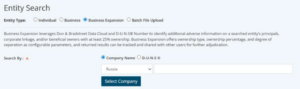
- Once the party’s country of origin and name have been selected/entered, click “Select Company” and then a gray list may populate with a list of similarly named entities.
- From here there are two possibilities:
A. If a grey list does populate and matches the party’s primary address, then select the applicable entity (if any), and click “Submit Search”, and proceed to Section C below.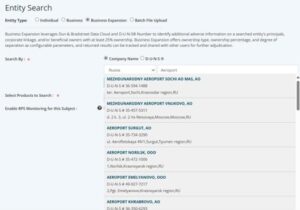
B. If a grey list does not populate (in other words if no entity is located in the system, the system will display “No records found”, and you must proceed to Section 6 below.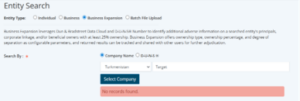
B. FOR INDIVIDUALS, SOLE PROPRIETORS, OR OTHER NON-LEGAL ENTITIES
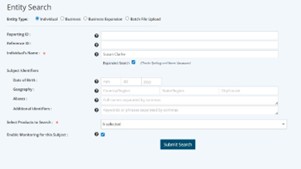
- If the party being screened is an individual, sole proprietor, or other non-legal entity, after logging into the RPSI system: (1) select “Individual” (next to Entity Type), (2) make sure the checkbox stating “Checks Spelling and Name Variations” is checked, (3) make sure the checkbox stated “Enable Monitoring for this Subject” is checked, (4) enter the party’s name, (5) do not fill out any other fields in this area, (6) click “Submit Search”, and (7) proceed to Section C below.
C. FOR ALL – REVIEW RESULTS IN “CASE MANAGEMENT”
- For all parties being screened (whether a legal entity, an individual, a sole proprietor, or another non-legal entity), once you click “Submit Search” (pursuant to Section A or B above):
- Wait for the search to process, and then hover over and click “Case Management” on the lefthand column.
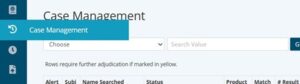
- From there, you will see (in the fourth column, under the word “Status”) either:
- “No Results Found”, in which case, read the two notes below (in Section C), and if nothing more is required at this time as a result of those two notes, you may do business with the party you’ve screened (after you comply with the portion of the URUS Sanctions and Export Compliance Policy that pertains to Export Controls – Prohibited/Restricted Items (and, of course, if you otherwise comply with all other applicable URUS policies, any other policies applicable to you and/or your Opco, and all other laws, rules, and regulations that might apply)), or
- “Results Found”, in which case, read the two notes below (in Section C), and if nothing more is required at this time as a result of those two notes, then notify the Legal Department and ask them to ascertain whether the party is restricted. We cannot do business with any restricted party.
- “No Results Found”, in which case, read the two notes below (in Section C), and if nothing more is required at this time as a result of those two notes, you may do business with the party you’ve screened (after you comply with the portion of the URUS Sanctions and Export Compliance Policy that pertains to Export Controls – Prohibited/Restricted Items (and, of course, if you otherwise comply with all other applicable URUS policies, any other policies applicable to you and/or your Opco, and all other laws, rules, and regulations that might apply)), or
Important Note: You will see a green circle on the righthand side (under “Monitor”), which indicates that the party will be continuously monitored through recurring automated checks, and you will receive an email if the party’s status changes. Should this happen, reperform the steps in this Section 5 (through to the end of these Instructions).
Note: The logo next to a legal entity will be a silhouette of a building, and the logo next to an individual (or sole proprietor or other non-legal entity) will be the silhouette of a person. If the appropriate logo is not displayed, reperform the steps in this Section 5 (through to the end of these Instructions).
6. Secondary Screening – IF “NO RECORDS FOUND” IS SHOWN IN THE RPSI SYSTEM
If you run the search above and receive a message “No Records Found”, you must run a secondary search to ensure the party is not restricted (in at least the country/jurisdiction where the party is organized). (The “No Records Found” message can result if, for example, the information obtained by URUS does not perfectly align with the information stored in the RPSI system, or if D&B simply does not have the non-URUS party in its records).
For the US:
Perform the secondary screening using the Consolidated Screening List hosted by the US International Trade Administration on its website (https://www.trade.gov/datavisualization/csl-search). When doing so, it is critical to toggle “On” under the “Fuzzy Name” category, to ensure that similar matches are generated.
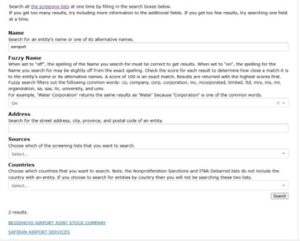
If the results (after clicking “Search”) contain a name that is similar to the party being screened, then you must request from that party:
- Physical Address; or
- Tax ID; or
- Passport information (if that party is an individual).
You must then use that information to reperform the secondary screening of the party (pursuant to this Section 6).
If a secondary search is conducted (and neither the primary screening, the secondary screening, nor the reperformance of the secondary screening indicates that the party is restricted), you must retain records of the searches on your and your Opco’s system for future audit purposes, and you may do business with the party you screened (after you comply with the portion of the URUS Sanctions and Export Compliance Policy that pertains to Export Controls – Prohibited/Restricted Items (and, of course, if you otherwise comply with all other applicable URUS policies, any other policies applicable to you and/or your Opco, and all other laws, rules, and regulations that might apply)).
If the secondary screening or the reperformance of the secondary screening indicates that the party is restricted, we cannot do business with that party.
Outside the US:
Consult with outside legal counsel to determine which regulatory sanctions regimes may apply to your Opco and which links/tools you should use to perform the secondary search. If you are unsure which legal counsel to contact, reach out to the Legal Department for guidance. Be sure to comply with all laws, rules, regulations, and policies governing economic sanctions (as well as with the portion of the URUS Sanctions and Export Compliance Policy that pertains to Export Controls – Prohibited/Restricted Items (and, of course, all other applicable URUS policies, any other policies applicable to you and/or your Opco, and all other laws, rules, and regulations that might apply)).
Document Control |
|
Version | 3.2 |
Date released | 2026.05.01 |
Author(s) | Member of Legal Department (Tina Wilcox) & General Counsel (Jen Wellnitz) |
For Questions Contact | Member of Legal Department (Tina Wilcos) |
Responsible | General Counsel (Jen Wellnitz) |
Accountable | CEO URUS (Paul Hunt) |
Consulted/Approved | CFO URUS (Ryan Gaines) |
Informed | See Document Control for the URUS Sanctions and Export Compliance Policy |